The lines between permanent, contractual, and gig work are increasingly blurred in India’s evolving labour market. For HR teams and business owners, understanding EPF obligations for contract and gig workers is critical — both to protect workers and to avoid compliance exposure. The law in this area is clear for contractors but still evolving for gig and platform workers.
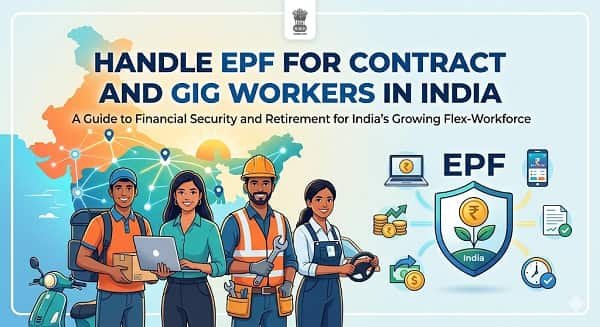
Contract Workers and EPF: The Principal Employer’s Responsibility
Under the Contract Labour (Regulation and Abolition) Act, 1970, and the EPF Act, the principal employer (the company that engages a contractor) is ultimately responsible for EPF compliance for all contract workers deployed at its establishment.
What This Means in Practice
- If a contractor fails to enroll their workers in EPF or defaults on contributions, the principal employer must step in and pay the dues
- The principal employer’s establishment employee count includes contract workers for threshold purposes
- EPFO inspectors regularly audit principal employers for contractor non-compliance
How to Protect Your Company
- Insist on EPF compliance certificates from all contractors before awarding or renewing contracts
- Include EPF compliance as a mandatory clause in contractor agreements with indemnity provisions
- Periodically verify contractors’ ECR filings and TRRN receipts for your establishment
- Retain the right to deduct EPF amounts from contractor payments if they default
EPF Contribution Rates for Contract Workers
The same EPF contribution rates apply — 12% of basic wages from the employee and 13.61% from the employer (contractor). If the contractor does not have their own PF code, the principal employer must register the contract workers under their own establishment code.
Gig Workers and EPF: The Current Legal Position
Gig workers — those working for app-based platforms like food delivery, cab aggregators, and e-commerce logistics — currently fall in a legal grey zone for EPF. As of 2025, gig workers are typically classified as “independent contractors” and are not covered under the EPF Act, which applies to employer-employee relationships.
The Code on Social Security, 2020
The Code on Social Security, 2020 — one of India’s four new labour codes — specifically includes a chapter on social security for gig and platform workers. It provides for the creation of a social security fund for such workers, to be funded by platform companies and the government. However, the specific rules governing EPF for gig workers under this Code are yet to be notified as of early 2025. When notified, the EPF framework for gig workers will change significantly.
Interim Steps Platforms Can Take
- Voluntarily extend EPF or similar retirement savings benefits to long-tenured gig workers
- Contribute to NPS (National Pension System) for gig workers as an interim measure
- Track regulatory developments on the Labour Codes and prepare compliance frameworks in advance
Misclassification Risk
If your “contractual” or “gig” workers are effectively working under your direction and control — fixed hours, exclusive engagement, no freedom to decline work — they may be classified as employees by EPFO inspectors. This can trigger retrospective EPF demands. Review your worker classification carefully with legal counsel.
Frequently Asked Questions
Q: Is the principal employer liable if a contractor runs away without paying EPF?
A: Yes. Under Section 17(3) of the EPF Act, the principal employer is fully liable to make good any EPF default by the contractor. This is a strict liability provision with no exception.
Q: Do contract workers need a separate UAN from their contractor employer?
A: UANs are personal to the worker and portable across employers. The contractor must enroll contract workers under the contractor’s own EPF code. Workers retain the same UAN when they move across contractors or establishments.
Q: Are freelancers covered under EPF?
A: No. Freelancers who work as independent contractors without any employment relationship are not covered under EPF. However, they can voluntarily enroll in NPS or PPF for retirement savings.
Q: When will gig workers get EPF benefits in India?
A: The Code on Social Security, 2020 has provisions for gig workers, but the rules have not been notified yet as of 2025. Once the Central Government notifies the rules, platform companies will need to contribute to a social security fund for gig workers.
Q: Can a company that uses multiple contractors manage all their EPF compliance centrally?
A: Yes. Principal employers can negotiate centralized EPF management agreements where the principal employer’s EPF code is used for all contract workers, simplifying compliance tracking. This requires specific sub-code registration at the regional EPFO office.