Knowing exactly how much monthly pension you will receive from EPS after retirement is a critical part of retirement planning. Yet many EPFO members remain unaware of the EPS pension formula, how pensionable salary is calculated, what counts as qualifying service, and how bonus years and early retirement affect the final pension amount.
This guide breaks down the complete EPS pension calculation methodology with step-by-step instructions, detailed examples for different service scenarios, and a comparison of pension amounts under standard and higher-wage options. Whether you are 10 years from retirement or just starting your career, understanding this formula helps you plan your retirement income accurately.
The EPS Pension Formula
| Formula Component | Definition | Key Rule |
| Monthly EPS Pension | (Pensionable Salary × Pensionable Service) ÷ 70 | Basic formula for all members |
| Pensionable Salary | Average of last 60 months’ EPS wages | Subject to Rs. 15,000 wage ceiling |
| Pensionable Service | Total EPS-covered years of employment | Fractions ≥ 6 months round up |
| Bonus Service | 2 additional years added | Only if service ≥ 20 years |
| Early Pension Factor | Reduction of 4% per year before age 58 | Applicable if pension drawn before 58 |
Step 1 – Calculate Pensionable Salary
Pensionable salary is the average of the last 60 months’ (5 years’) wages on which EPS contributions were made, subject to the wage ceiling. In most cases, the ceiling is Rs. 15,000 per month, so the pensionable salary for standard members is capped at Rs. 15,000 regardless of actual salary. For members who opted for higher pension on actual wages, pensionable salary reflects the actual average.
Example: An employee earning Rs. 25,000 basic for the last 5 years, under standard rules, has a pensionable salary of Rs. 15,000 (ceiling). Under the higher pension option (if approved), pensionable salary = Rs. 25,000.
Step 2 – Calculate Pensionable Service
Pensionable service is the total number of years during which EPS contributions were made, accumulated across all employers linked to your UAN. Key rules:
- Each year of service with an employer where EPS contributions were made counts as qualifying service.
- If service in the last partial year is 6 months or more, it rounds up to a full year.
- If service in the last partial year is less than 6 months, it is ignored.
- Service breaks of less than 2 months between employers do not break continuity.
- A bonus of 2 additional years is added if total pensionable service is 20 years or more.
Comprehensive Pension Calculation Examples
| Scenario | Pensionable Salary | Raw Service | Bonus | Total Service | Monthly Pension |
| 30 years, standard wages | Rs. 15,000 | 30 | 0 | 30 | Rs. 6,428 |
| 20 years, standard wages + 2 yr bonus | Rs. 15,000 | 20 | 2 | 22 | Rs. 4,714 |
| 25 years, standard wages + 2 yr bonus | Rs. 15,000 | 25 | 2 | 27 | Rs. 5,786 |
| 10 years minimum eligible | Rs. 15,000 | 10 | 0 | 10 | Rs. 2,142 |
| 35 years, standard wages + 2 yr bonus | Rs. 15,000 | 35 | 2 | 37 | Rs. 7,929 (approx) |
| 30 years, higher pension Rs.40,000 | Rs. 40,000 | 30 | 0 | 30 | Rs. 17,142 |
Impact of Early Pension (Drawing Before Age 58)
If you choose to draw your EPS pension before age 58 (minimum age 50), the pension is permanently reduced by 4% for each year before 58:
| Age at Pension Start | Reduction | Formula Adjustment |
| 58 (full pension age) | None | Full calculated pension |
| 57 (1 year early) | 4% reduction | Pension × 0.96 |
| 56 (2 years early) | 8% reduction | Pension × 0.92 |
| 55 (3 years early) | 12% reduction | Pension × 0.88 |
| 54 (4 years early) | 16% reduction | Pension × 0.84 |
| 53 (5 years early) | 20% reduction | Pension × 0.80 |
| 50 (8 years early, minimum) | 32% reduction | Pension × 0.68 |
How to Calculate Your Expected EPS Pension – Quick Method
| 1 | Find your average basic salary + DA for the last 60 months (cap at Rs. 15,000 for standard EPS). |
| 2 | Count your total years of EPS-covered service across all employers (via EPFO portal). |
| 3 | If total service is 20+ years, add 2 bonus years to your service count. |
| 4 | Apply the formula: Monthly Pension = (Pensionable Salary × Total Service) ÷ 70. |
| 5 | If you plan to draw pension before 58, reduce by 4% for each year before 58. |
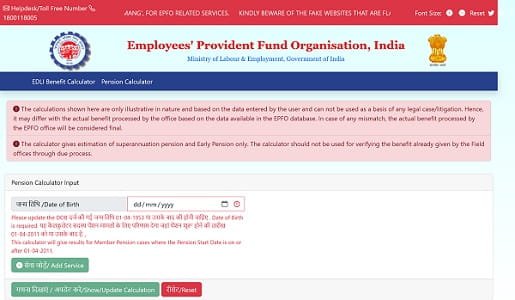
| 6 | Cross-check using EPFO’s online pension calculator or contact your Regional Office. |
Frequently Asked Questions (FAQs)
Q1. Why is the divisor 70 in the EPS pension formula?
Ans: The number 70 in the EPS pension formula is a statutory constant set by the government when the Employees’ Pension Scheme was established in 1995. It was designed to produce a pension that is actuarially balanced — meaning the contributions from employers and government across all working members are sufficient to sustain the pension payouts to retired, disabled, and deceased members’ families over time. The divisor of 70 essentially ensures that the pension fund remains solvent across the entire pensioner population. Increasing the divisor to a larger number would reduce pensions; decreasing it would increase pensions but risk fund viability. There have been periodic calls to reduce the divisor to improve pension adequacy, but it remains unchanged at 70 in 2026.
Q2. Can I increase my EPS pension by contributing for more years?
Ans: Yes. Every additional year of EPS-covered service directly increases your pension, since service years are a multiplier in the formula. An employee working 35 years (+ 2 bonus = 37 years) receives significantly more pension than one working only 20 years. The most effective strategy to maximize EPS pension is to start employment early, avoid EPS withdrawals (which forfeit past service for pension purposes), and continuously transfer (not withdraw) your PF when changing jobs to maintain uninterrupted pensionable service. Higher wages (via the higher pension option) also dramatically increase pension for those eligible, as pensionable salary is the other key multiplier.
Q3. What is the minimum monthly EPS pension guaranteed by the government?
Ans: EPFO guarantees a minimum monthly EPS pension of Rs. 1,000 per month for all pensioners — including members, widows, widowers, and children — regardless of what the formula calculation produces. This minimum was introduced in 2014 following government intervention to address the very low pensions that resulted from the formula when wages and service were limited. So even if the formula calculation yields a pension below Rs. 1,000 (for example, a member with just 10 years of service at Rs. 15,000 wages = Rs. 2,142, which exceeds the minimum), all pensioners receive at least Rs. 1,000. Widow and children pensioners whose calculated amount is below Rs. 1,000 also receive this floor.
Q4. Is EPS pension revised periodically for inflation?
Ans: Unlike government pensions (like central or state government employee pensions), EPS pension under EPFO does not have an automatic annual Dearness Allowance (DA) revision linked to inflation. The pension amount is fixed at the time of retirement based on the formula and does not increase in subsequent years unless the government announces a special revision. There have been periodic ad-hoc increases to the minimum pension (from Rs. 600 to Rs. 1,000 in 2014) and calls for a structured revision mechanism, but as of 2026, no formal DA or inflation indexation is built into standard EPS pension payments. This is one of the most significant criticisms of EPS, as the real purchasing power of the pension erodes over time due to inflation.
Q5. How does the pension calculation change under the higher pension option?
Ans: For members who are approved for the higher pension option (following the Supreme Court’s 2022 judgment), the pensionable salary in the formula is based on their actual wages rather than the Rs. 15,000 ceiling. This dramatically changes the pension calculation. For example, an employee earning Rs. 50,000 monthly basic salary with 30 years of service: Standard EPS pension = (15,000 × 30) ÷ 70 = Rs. 6,428/month. Higher pension = (50,000 × 30) ÷ 70 = Rs. 21,428/month — more than three times the standard pension. The higher pension option requires retroactive EPS contributions on the higher wage base to be deposited, which can be a significant lump sum, but the long-term pension income benefit is substantial for high-salary employees.
Conclusion
The EPS pension formula is simple but powerful. Two variables — pensionable salary and pensionable service — determine your retirement income for life. Maximizing both by maintaining continuous service, avoiding EPS withdrawals, and exploring the higher pension option if eligible gives you the highest possible guaranteed lifetime income from EPS.
Use the formula and examples in this guide to estimate your expected pension, factor it into your overall retirement income plan alongside your EPF corpus and other savings, and make informed decisions about early pension options, job changes, and contribution levels throughout your career.