



Discovering that your employer has been deducting EPF from your salary but not depositing it with EPFO is an alarming situation — and unfortunately, not uncommon, particularly in small and medium enterprises facing cash flow stress. Your hard-earned retirement savings are at risk, and the employer may be committing a criminal offence. But you are not helpless. Here is exactly what you should do, step by step.
Step 1: Confirm That EPF Is Actually Not Being Deposited
Before escalating, verify the situation using EPFO’s own tools:
Check Your EPF Passbook
- Log in to the EPFO member portal (unifiedportal-mem.epfindia.gov.in) or use the UMANG app
- Go to View > Passbook
- Check the monthly entries — each month should show a credit entry for both employee and employer contribution
- Identify months where entries are missing despite salary being paid and EPF being deducted
Missed Call Balance Check
Give a missed call from your registered mobile number to 9966044425. EPFO will send an SMS with your latest balance and last contribution details.
If you see months with no EPF credit but your salary slip shows PF deduction, your employer is almost certainly deducting but not remitting. This is a serious legal violation.
Step 2: Raise the Issue Internally
Before filing a formal complaint, attempt an internal resolution:
- Email your HR or finance department asking for clarification on the missing EPF credits
- Request copies of the ECR challans (TRRN receipts) for the months in question — these prove whether payment was made to EPFO
- Keep all written communication — this documentation will be valuable if you need to escalate
Some genuine errors — like payroll system glitches, bank transfer failures, or ECR filing mistakes — can cause apparent non-deposits that are resolved quickly once flagged internally.
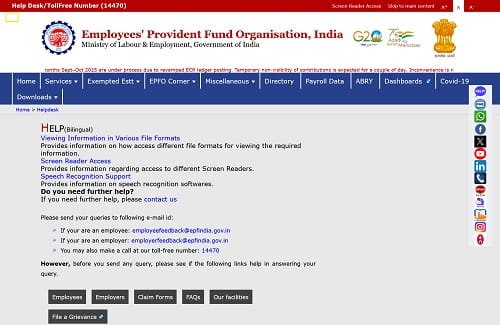
Step 3: File a Complaint on the EPFO Grievance Portal
If the internal approach fails or if the employer is clearly defaulting, file a formal complaint:
- Visit the EPFO Grievance Portal: epfigms.gov.in
- Click on “Register Grievance”
- Select your establishment from the dropdown (search by PF code or establishment name)
- Choose “Employer Related Issues” as the grievance category
- Select “Employer Not Depositing Contributions” as the specific issue
- Provide details: months of non-deposit, amounts deducted from salary, your UAN, and any supporting documents
- Submit and note your grievance registration number for tracking
EPFO has a 30-day grievance resolution target. The complaint triggers an enforcement inquiry against the employer.
Step 4: File a Complaint with the EPFO Regional Office
For stronger enforcement action, approach the EPFO regional office directly:
- Write a formal complaint letter addressed to the Regional PF Commissioner
- Attach salary slips showing EPF deductions for the months in question
- Attach your passbook printout showing missing credits
- The regional office will issue a notice to the employer and initiate recovery proceedings under Section 7A of the EPF Act
Step 5: File a Complaint Under Section 14 of the EPF Act
If the employer has deducted your EPF contribution but withheld it, they are guilty of a criminal offence under Section 14 of the EPF Act — specifically, misappropriation of employee’s deducted contribution. Punishment under Section 14 includes:
- Imprisonment of up to 3 years (with minimum 1 year) when contributions have been deducted but not paid
- Fine up to Rs 10,000
You can file a criminal complaint before the jurisdictional magistrate court, though in practice most employees pursue the EPFO administrative route first before going to court.
EPFO’s Recovery Powers
Once EPFO takes up your complaint, it has strong recovery powers:
- Issue demand notice under Section 7A for determination of the amount due
- Attach employer’s bank accounts and assets
- Issue Recovery Certificate (RC) to the District Collector for coercive recovery
- Blacklist the establishment from government contracts in serious cases
What About Your Future Employment?
If you resign because of this situation, you can still withdraw the portion of EPF that was actually deposited. For the unremitted months, EPFO will attempt recovery and credit the recovered amounts to your account. In serious default cases, you may need to wait for the recovery process to complete before claiming the undeposited amounts.
Frequently Asked Questions
Q: Can I claim the EPF that was deducted but not deposited?
A: Once EPFO recovers the dues from the employer, the amount is credited to your account and becomes claimable. If the employer is insolvent or has disappeared, recovery may be partial or delayed, but EPFO continues to pursue the employer’s assets and directors.
Q: Will I face any penalty or tax if I withdraw EPF after an employer default situation?
A: No additional penalty or tax applies to you as the employee in this situation. If the non-deposit stretched your EPF membership below 5 years of continuous service, standard premature withdrawal tax rules apply to the withdrawn amount.
Q: How long does EPFO take to resolve a non-deposit complaint?
A: Initial grievance acknowledgment happens within a few days. The enforcement process — investigation, demand notice, employer response — typically takes 30 to 90 days. Recovery from an unwilling or insolvent employer can take much longer, especially if legal proceedings are involved.
Q: Should I continue working at the company while EPFO investigates?
A: That is a personal decision based on your financial situation and the severity of the default. Documenting the situation thoroughly and securing alternative employment is advisable if the employer appears to be in serious financial distress. Your EPF complaint rights are independent of your employment status.
Q: Is it a good idea to expose this publicly on social media to pressure the employer?
A: Focus on the formal legal channels first — the EPFO grievance portal, regional office complaint, and if needed, the magistrate court. Public pressure has occasionally helped in high-profile cases, but the administrative and criminal provisions of the EPF Act are significantly more effective and give you concrete legal remedies.