



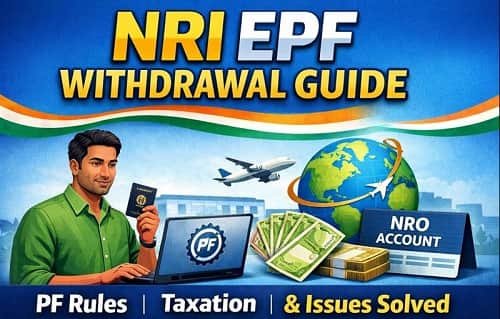
Thousands of Indian professionals who have moved abroad as Non-Resident Indians (NRIs) have accumulated EPF balances during their years of employment in India. Managing, withdrawing, or transferring these balances from outside India involves a specific set of rules and tax implications that are often misunderstood. This guide covers everything NRIs need to know about their EPF accounts in 2026.
Can NRIs Continue EPF Contributions While Living Abroad?
EPF is tied to Indian employment. If you are working for an Indian company and receiving a salary through Indian payroll — even while living abroad temporarily — EPF contributions can continue. However, if you are employed by a foreign company outside India and paid in a foreign currency without an Indian employment arrangement, you are generally not eligible to make fresh EPF contributions.
What Happens to Your EPF When You Become an NRI?
When you leave India for employment abroad and become an NRI, your existing EPF account remains intact. The balance continues to earn interest as long as you are below 58 years of age. The account does not automatically close or stop earning interest simply because you have become an NRI.
Can NRIs Withdraw EPF?
Yes. NRIs can withdraw their EPF balance under the same conditions that apply to resident Indians:
- Full withdrawal after retirement (58 years) or 2+ months of unemployment
- Partial withdrawal for specific purposes (medical, education, marriage, housing) if conditions are met
The withdrawal can be credited to an NRE or NRO bank account in India. EPFO does not directly remit to foreign bank accounts — the amount must first be received in an Indian account.
Tax on EPF Withdrawal for NRIs
Resident Status at Time of Withdrawal
EPF withdrawal tax treatment depends on your residential status in India at the time of withdrawal, not when the contributions were made:
- If you withdraw EPF while still classified as NRI: The withdrawal may be subject to TDS at 30% (plus surcharge and cess) if the withdrawal is within 5 years of continuous EPF service — significantly higher than the 10% applicable to residents
- If you withdraw EPF after becoming a resident Indian again (returned to India): The resident rules apply — tax-free after 5 years of continuous service, 10% TDS if less than 5 years
Double Taxation Avoidance Agreement (DTAA) Relief
India has DTAA (tax treaties) with many countries including the USA, UK, UAE, Canada, Australia, Singapore, and Germany. If your country of residence has a DTAA with India:
- The EPF interest income earned in India may be taxed at a reduced rate as per the treaty
- You may be able to claim credit for Indian taxes paid against your foreign tax liability
- Some treaties provide specific relief for provident fund income
File Form 10F and provide a Tax Residency Certificate (TRC) from your country of residence to claim DTAA benefits in India.
EPF Interest for NRIs: Is It Taxable in India?
For resident Indians, EPF interest is tax-free under Section 10(11) and 10(12) up to the Rs 2.5 lakh annual contribution limit. For NRIs, the tax treatment of EPF interest depends on DTAA provisions and whether the interest is classifiable as exempt income in India. Most NRIs with no fresh EPF contributions simply have the accumulated balance earning interest — this interest is typically not separately taxable in India for NRIs as long as the EPF account qualifies under Section 10.
KYC and Account Management From Abroad
NRIs can manage their EPF accounts online through the EPFO member portal. However:
- Aadhaar OTP verification requires an Indian mobile number — if your number has changed, updating it may require visiting an Indian bank or using UMANG app
- Claims can be filed online if KYC is complete and Aadhaar is linked
- For complex issues, a Power of Attorney (PoA) holder in India can represent you at the EPFO office
Frequently Asked Questions
Q: Can an NRI transfer EPF balance to a pension plan abroad?
A: No. EPF cannot be directly transferred to foreign pension plans. The only option is to withdraw the EPF balance (subject to conditions and tax) and then invest the proceeds abroad as per FEMA regulations.
Q: Does an NRI need to pay tax in India on EPF withdrawal?
A: If the EPF membership has been for more than 5 continuous years and the NRI withdraws after that period, the withdrawal is generally exempt from Indian tax under Section 10. If less than 5 years, TDS is applicable. DTAA provisions may further reduce the tax burden depending on the country of residence.
Q: Can NRIs use Form 15G/15H to avoid TDS on EPF withdrawal?
A: No. Forms 15G and 15H are available only to resident Indians. NRIs cannot use these forms to prevent TDS. However, they can apply for a lower TDS certificate under Section 197 of the Income Tax Act by filing an application with the Indian tax authorities.
Q: Is there a deadline by which NRIs must withdraw EPF?
A: There is no strict deadline. The EPF balance earns interest until age 58 and can be claimed at any future point. However, allowing the account to sit dormant beyond 3 years without action may classify it as inoperative (though interest continues until age 58). Withdrawing or transferring while still relatively young is generally advisable.
Q: How can NRIs file EPF claims from abroad?
A: NRIs can file EPF claims online via the EPFO member portal if KYC is complete. If the online process is not accessible, a PoA holder in India can file on their behalf at the regional EPFO office. The withdrawal amount is credited to the Indian NRE/NRO bank account specified in the claim form.