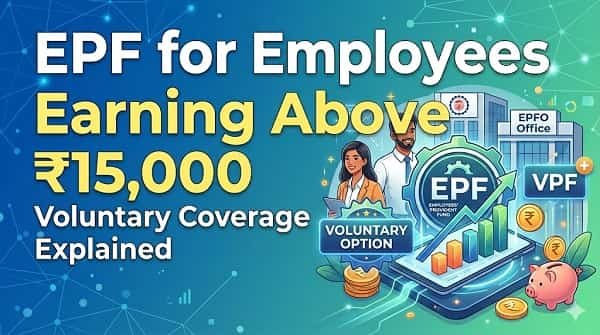
The statutory wage ceiling for mandatory EPF enrollment is Rs 15,000 per month (basic + DA). Employees earning above this threshold who are new to EPF are not compulsorily enrolled. However, existing EPF members and those who voluntarily opt in continue to contribute — sometimes on much higher wages. Understanding how voluntary EPF coverage works above the Rs 15,000 limit is important for both employees and employers planning payroll and benefits strategy.
The Rs 15,000 Ceiling: What It Means
When EPF was restructured in 2014, the wage ceiling was revised from Rs 6,500 to Rs 15,000. This means:
- Employees whose basic + DA is Rs 15,000 or below: EPF enrollment is mandatory
- Employees whose basic + DA exceeds Rs 15,000 who are new to EPF: Enrollment is optional (they can choose to join or not join)
- Existing EPF members who get a salary hike above Rs 15,000: They continue as EPF members and contributions may continue on the actual salary or can be restricted to Rs 15,000
Option 1: Contribute Only on the Statutory Ceiling (Rs 15,000)
Both the employee and employer can agree to restrict EPF contributions to 12% of Rs 15,000 = Rs 1,800/month each, regardless of actual salary. This is the most common approach for higher earners — it satisfies the statutory obligation while keeping the employer’s cost lower.
Option 2: Contribute on Actual Higher Wages
Employer and employee can mutually agree to contribute on the actual EPF wages (above Rs 15,000). For example, if the employee’s basic salary is Rs 40,000, contributions can be 12% of Rs 40,000 = Rs 4,800/month from the employee.
Note: Regardless of whether contributions are made on Rs 15,000 or the actual salary, the EPS contribution is always capped at 8.33% of Rs 15,000 = Rs 1,250/month. The excess employer contribution above EPS goes entirely into the EPF account.
Voluntary Provident Fund (VPF) — The Better Tool for High Earners
For employees who want to invest more than 12% of their basic salary into a PF-like instrument, VPF (Voluntary Provident Fund) is a superior route:
- VPF allows contributions up to 100% of basic + DA from the employee’s side
- VPF earns the same interest rate as EPF (8.25% for FY 2023-24)
- VPF qualifies for Section 80C deduction (within the Rs 1.5 lakh cap)
- Interest on VPF is tax-free up to Rs 2.5 lakh combined annual employee contribution (EPF + VPF)
- Employer is not required to match VPF — it is purely employee contribution
The Higher Pension Option Under EPS (Post Supreme Court Judgment)
A Supreme Court judgment in November 2022 gave eligible EPF members the opportunity to opt for higher EPS pension by contributing 8.33% on their actual salary (above the Rs 15,000 ceiling) to EPS instead of the EPF. EPFO opened a window for this, which has since passed for most employees. New members joining after September 1, 2014 are not eligible for this higher pension option.
Should You Voluntarily Opt Into EPF Above Rs 15,000?
For new employees earning above Rs 15,000 who have not previously been EPF members, the decision to voluntarily opt in depends on:
- Tax bracket: For employees in 30% bracket, EPF’s effective tax-adjusted return is very attractive
- Investment discipline: EPF’s forced saving nature is beneficial for those who tend to spend surplus
- Existing 80C utilisation: If 80C is already exhausted, the marginal tax benefit of additional EPF contribution is limited
- Long-term goals: EPF’s illiquidity suits pure retirement savers, not those who need mid-term access
Frequently Asked Questions
Q: Can an employer force an employee earning above Rs 15,000 to join EPF?
A: No. For a new employee who has never been an EPF member and whose basic salary exceeds Rs 15,000, EPF enrollment is their choice. An employer cannot compel enrollment. However, once an employee agrees to join and EPF contributions begin, the arrangement is binding for both parties.
Q: If I earn Rs 60,000 basic and contribute on Rs 15,000, what is my annual EPF corpus growth?
A: At Rs 15,000 ceiling, your monthly contribution is Rs 1,800 and employer EPF contribution is about Rs 550 (the rest goes to EPS). Annual addition of about Rs 28,200 to your EPF account at 8.25% interest.
Q: What are the tax implications if contributions are made on actual salary above Rs 15,000?
A: The employee’s contribution on actual salary qualifies for 80C (up to Rs 1.5 lakh). The employer’s contribution is non-taxable up to the Rs 7.5 lakh annual limit across EPF/NPS/superannuation. Interest on employee contribution is tax-free up to Rs 2.5 lakh annual contribution.
Q: Can I change the contribution basis (Rs 15,000 vs actual) mid-year?
A: Changes to the EPF contribution basis generally require mutual agreement between employer and employee and are reflected in the monthly ECR. Mid-year changes are allowed but must be consistently applied from the revision month. Consult your payroll team or PF consultant for the correct process.
Q: Is the employer obligated to match VPF contributions?
A: No. VPF is purely an employee’s voluntary contribution. Employers have no legal obligation to match VPF. The employer’s contribution is limited to the mandatory 12% on EPF wages (or the agreed voluntary amount, capped at 12% from the employer side).